-
 play_arrow
Radio Rehoboth
music_note


Tax bill delays, data gaps hindered reassessment, officials say


DOVER— Delays in the new tax bills and gaps in property reassessment data were the culprit of the mishandling of New Castle County reassessment since 1983, according to testimony heard before state lawmakers on Tuesday.
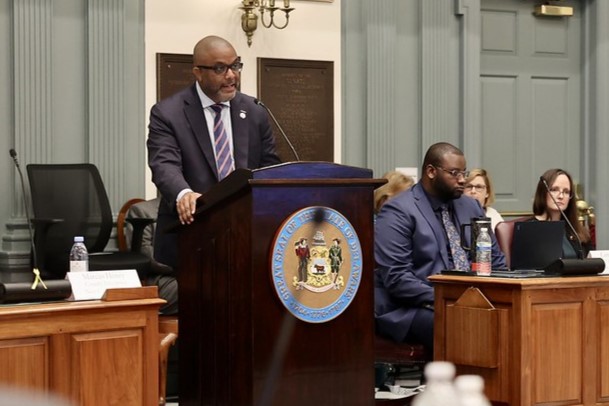
In a five-hour hearing, New Castle County and Wilmington officials outlined many of their own internal findings for a bipartisan special committee, including a revelation that the previous county executive — Gov. Matt Meyer— had delayed the roll out of the tax bills until November.
New Castle County Executive Marcus Henry told the committee that it was his understanding that the Meyer administration had gone against advice to issue the preliminary reassessed property values in spring 2024. Instead, the notices were mailed out in mid-November after the election.
“It is our understanding that New Castle County’s assessment team recommended several times that the tentative value notices go out in the summer of 2024 it is also our understanding that the prior administration said no to those recommendations,” Henry said. “Instead, the assessment office was advised that tentative value notices couldn’t go out until mid-November.”
Reassessment impacted 215,000 property parcels in New Castle County and thousands more throughout the state. In the county, about 180,000 residential properties saw their valuation go up.
“People are already struggling under the weight of this economy, and we have a responsibility to help them,” Henry said. “New Castle County residents deserve more, and I have and will continue to do everything in my power to provide assistance to the fullest extent legally permissible.”
The decision to wait likely cost thousands in New Castle County time to appeal their reassessed value, which would impact the final tax bill. Henry said the appeal process started immediately afterwards and during the administration changeover. Final reassessed values were mailed to local jurisdictions and school districts in February.
Sen. Eric Buckson (R-East Dover) pointed out that the informal appeal process was critical in Kent County, which saw its reassessment process completed in 2023 with the new values in effect for fiscal year 2024.
“It was a simple decision that has caused this state and New Castle County constituents and residents’ problems and has unfairly laid the blame at the existing New Castle County administration,” Buckson said.
A comment from Meyer, who was New Castle County Executive for eight years before he was elected governor last year, was not immediately available.
In his first budget, Henry set a split tax rate for non-residential and residential properties, while the school districts in the county were tied to one rate until emergency legislation was passed in August.
New Castle County has already spent or allocated $20 million for reassessment, including extending the contract with Tyler Technologies four times and likely will see another extension. The county is getting about 120 calls per day on reassessment issues, as many homeowners are shocked at their tax bills and some unsure how they will manage to pay it.
The county has reportedly hired additional staff members to handle some reassessment calls, as it’s almost impossible for the county staff to address valuation issues from the process.
Tyler Technologies used mass appraisal for the reassessment, meaning that the firm used
large-scale evaluations of many properties at
one time through statistics and data collection. The data used was the neighborhoods, costs and income as well as sales comparison of the group of properties. This contrasts with individual reassessment, where each individual property is valued on its own merits.
Part of the problem was gaps in the data, according to Wilmington officials. Tyler Technologies used surveys and photographs of building exteriors, but not information on the interior, to base the values.
Those interior conditions can be a major driver of value but also an “extraordinary assumption” in the process, according to Tyler Technologies Senior Vice President Jake Wilson.
Wilmington also struggled under the short appeal window. Wilmington Mayor John Carney’s Chief of Staff Cerron Cade said the city started seeing issues with the raw data from the county but waited for a final report in June from Tyler Technologies, three months after the city’s budget was due.
But another critical issue was the lack of Wilmington permitting data being used during reassessment to determine values. Permits are essentially the paperwork that verifies property improvement and added value– and Wilmington does its own permitting.
Cade said it’s his understanding that New Castle County’s permitting data was used, but Wilmington’s was not. In the past, New Castle County had shared permitting data with Wilmington, but that practice had apparently ended during the pandemic.
“That is not simply a mistake of statistics or just tough cookies for urban assessments,” Cade said. “That is missing data that was supposed to be included in the Wilmington assessment that was not. [If] someone’s going to sit here and tell me that that has zero impact on the assessments, I would beg to differ.”
Wilmington also has a unique problem in how diverse its housing stock is, as not all areas of the city were built in the same era. The city is already wrestling to maintain affordable housing, and the market has essentially driven up the value of neighboring unsold properties. When the city or nonprofits build or renovate a home for income-restricted tenants, that also goes on the books and skews the valuation for the neighborhood.
To address these problems, Carney is seeking $500,000 from the Wilmington City Council to contract out a city-wide reassessment. This process will focus on interior reassessments for homes but will also include a methodology for commercial properties.
“I think we need to get a fix for it now, and I don’t think we should wait until next time to get this assessment right,” Cade said.
The next joint legislative committee hearing on reassessment is scheduled for Oct. 7.
Go to Source:https://delawarebusinesstimes.com/news/tax-bill-delays-reassessment-officials-say/
Author: Katie Tabeling
Similar posts

-

Legends of Disco
With DJ Tim
Listen and Dance to the Award Winning “Legends Of Disco” Show as he features the Best Of Classic Disco, Dance and R & B. on Thursdays from 8 pm to 11 pm. The passion, the knowledge, the memories! Tim hails from Philadelphia PA and now resides in Rehoboth Beach DE. He is having the time of his life and living his dream being your radio DJ.
close Top popular
Matt Damon Discusses Working With Wife Luciana on ‘The Instigators’

Listen to Jane Remover’s New Songs “Flash in the Pan” and “Dream Sequence”
NFL Week 17 highlights: Packers, 49ers, Saints, Steelers win, Cardinals stun Eagles

Demo underway on Sea Esta Motel in Dewey

Watch MexikoDro’s Video for New Song “Marta”